
About PWGN
The purpose of this website is to give commercial wine growers in Pennsylvania and the non-western wine states access to current and relevant viticulture news, information, and events that will enable them to grow high quality wine grapes. It will be a source of locally produced materials but also a portal to the amazing wealth of viticulture information available on the internet. The resources that reside on this site are carefully selected by the viticulture educator. It is central to our extension mission to discover and transfer practical research-based knowledge to the grape growing industry, but we also seek the best new ideas and technologies from innovative grower/practitioners. We hope you will find it useful and we welcome your comments and feedback. Thank you for visiting and please return often for more news and information.
I welcome your comments and suggestions about this website. Please send your ideas for future topics and how cooperative extension can help you and your vineyard to mlc12@psu.edu.
Read a brief summary of the Pennsylvania wine industry and look at PHOTOS of people and their vineyards.
NOTE: under the HOME tab are listed CONTACT US, DIRECTIONS and a PA Photo Gallery!
These organizations have generously funded the PA Wine Grape Network:
- The Pennsylvania State University College of Agricultural Sciences
- The Pennsylvania Wine Marketing and Research Program
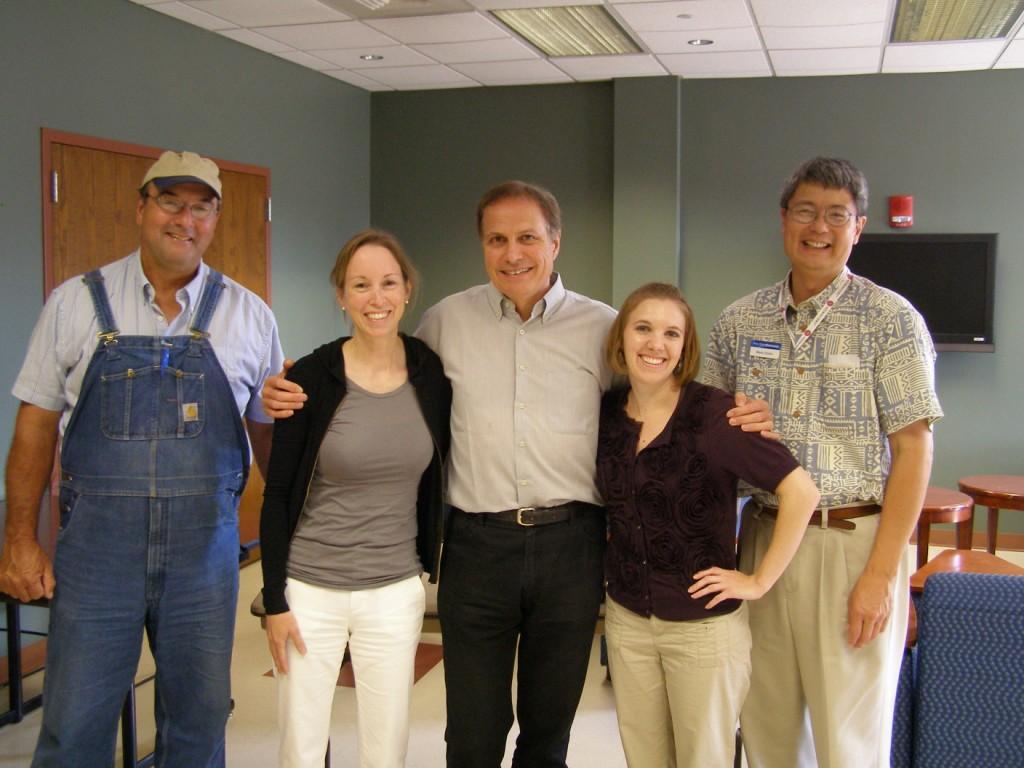
Dominic Strohlein, Sarah Troxell, Alain Razungles, Denise Gardner and Mark Chien at the PQA wine making workshop
Spotlight
 Changes at PWGN: The author and editor of the Pennsylvania Wine Grape Network is leaving Penn State, effective May 9, 2014 to begin work at the Oregon Wine Research Institute as their program director, starting on May 28, 2014. PWGN will remain active until a decision is made by a new viticulture extension educator about future of on-line viticulture extension resources. Users should continue to rely on the Information Resources list, new grape grower information, the regional events calendar, and other useful materials found in PWGN. Thank you for your use and support of PWGN over the years. Hopefully it will continue to be a valuable regional resource for viticulture news, information and events. Have a very fine vintage in 2014!
Grape Disease Information: Dr. Mizuho Nita, grape pathologist at Virginia Tech, recently gave two excellent presentations at a grower meeting in Chester County sponsored by Little Britain Ag Supply: Back to Basics – Phomopsis, Downy Mildew and Botrytis Bunch Rot, and Fungicide Trial Updates – Powdery Mildew, Downy Mildew, Botrytis and Late Season Rots. Given the disease challenges of 2013, this would be a good time to review vineyard IPM programs, and consider new products and practices that are available. Viewing these two talks would be an excellent start to drafting an IPM plan for 2014.
Growing Fine Red Wine in the Eastern U.S. for those who have tried it know what a challenge it can be. Two great minds in viticulture, Dr. Alan Lakso at Cornell and Dr. Kees van Leeuwen at ISVV/Universitie Bordeaux engaged in a discussion about getting Cabernet Franc ripe in the Finger Lakes, which I tried to extrapolate to red wines across the region. The process requires some deconstruction of terroir in which two critical elements, soil moisture and nitrogen, affect vine behavior. It’s a fascinating discussion for the curious and intellectual wine grower, and affects every vineyard for better or worse. Please read Is There a Formula for Fine Red Wine Production.
Articles about terroir explanation and analysis by Dr. Kees van Leeuwen: The Concept of Terroir in Viticulture, Journal of Wine Research, 2006; Influence of Climate, Soil and Cultivar on Terroir, Am J for Enol and Vitic, 55:3, 2004
E-Newsletter: Read about a new viticulture and terroir short course being offered in Bordeaux and upcoming meetings around the region in the most recent (1.9.14) viticulture e-newsletter Wine Grape Information for Pennsylvania and the Region.
Features
What I’m Reading: I went to graduate school at UC-Davis and even then he was scary smart to the rest of us. Clark has made a name for himself as a technologist in the cellar, but it would be wrong and unfair to assign any simple label to him, especially given his vast experience and talent. At the moment, the romanticists (wine writers, sommeliers, retailers, etc) have captured popular opinion about the virtues of natural wines, be they organic, biodynamic or whatever the latest fad may be. Clark brings some balance and reality back to the world of wine, and that we are, after all, the wine “industry” and as growers and wine makers, should not be ashamed of what we do, or how we do it. I have found Postmodern Winemaking to be an fascinating and educational book, most of it is above my basic enological skill level, but I would highly recommend it to all commercial wine professionals, on both sides of the production and retail fence!
All wine regions have colorful histories and Eastern N. America is no different. Pioneers such as Philip Wagner and Konstantin Frank helped to build a wine industry from scratch after prohibition ended. For the past four decades Hudson Cattell has documented the growth of the wine industry, mainly through his Wine East magazine, which was essential reading for anyone growing and making wine. He is really the only person who could writeWines of Eastern North America: from Prohibition to the Present and a History and Desk Reference. This is the definitive guide to the evolution of the modern day wine industry and filled with interesting fact and stories that only Hudson would know. It is published by Cornell University Press and advance copies can be ordered at a discounted price.
If there is one book that can be called the foundation of a wine library it would be The World Atlas of Wine. The seventh edition by Hugh Johnson and Jancis Robinson has just been released and is well worth adding to or update a library.
Featured Article(s): If you want to start a rumble among viticulture nerds, just mention the words vine density in their company, and debates of epic proportion will ensue, often quite passionate! This something we just can’t seem to agree upon, though it has been studied and tested exhaustively. Some new wine growers seeking fine wines have opened this can of worms again, which led me back to a seminal research article by Cesare Intireri and Ilaria Filippetti called Planting Density and Physiological Balance: “Comparing Approaches to European Viticulture in the 21st Century” from the Proceedings of the American Society for Enology and Viticulutre 50th Anniversary Meeting in June, 2000. It will undoubtedly stir up conversation, but the science and rational is so sound, even the strongest proponent of 20,000 vines per hectare may develop some doubts. In the end, the authors seek vine balance, not at the expense of density dogma.
Featured Web Sites and Webinars: The Northern Grapes Project, a regional USDA Specialty Crop Research Iniative project directed by Dr. Tim Martinson at Cornell University has put together a series of practical grape growing and wine making webinars. Topics include grape ripening, managing healthy fermentations, and impact of crop load and trellis system.
The National Grape Registry is THE source of information about grape varieties, clones and rootstocks, and it tells growers which nurseries produce these materials. As a companion to Wine Grapes (Robinson, Harding, Vouillamoz) these are the definitive reference resources for the wine industry.
Previous featured websites: University of California Integrated Viticulture, Northern Grape Projects, Ontario Grape IPM, Virginia Vineyards Association Resources, Linden Vineyards (see vintage summaries and article archives), Texas Winegrape Network, Cornell Research, VinoVic.